Control cron across
your infrastructure.
Know exactly what runs, where, and why — without SSH, guesswork, or hidden failures.
Cron breaks silently. Jobs drift across servers. No one knows who owns what. CronCommander gives you a single source of truth for every cron job, every execution, and every change.
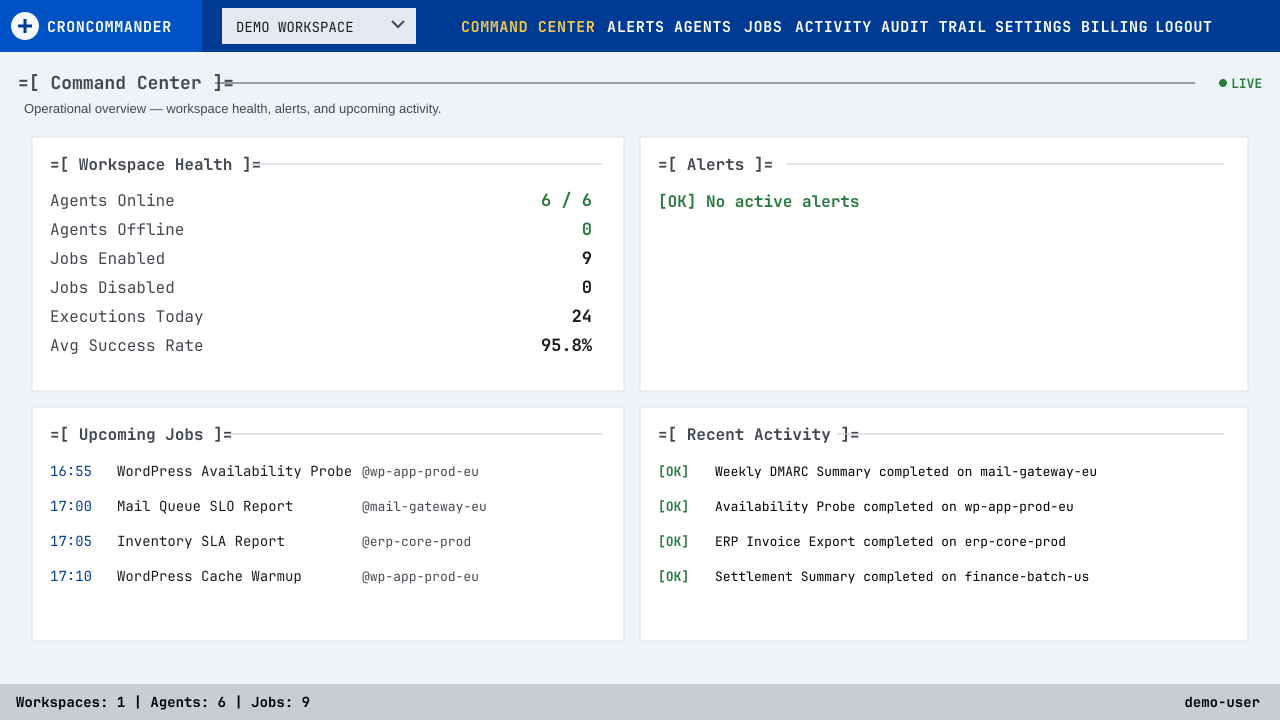
Product tour
How it works
A five-minute walkthrough of agent setup, client workspaces, job ownership, approvals, execution monitoring, and troubleshooting.
Video chapters
Choose a chapter to jump to that part of the demo.
- Introduction
- Empty workspace
- Workspace enrollment key
- Install the agent
- First agent online
- Connect more servers
- Client and team workspaces
- Discover and import cron jobs
- Workspace roles
- Create a job proposal
- Review and approve changes
- Synchronize managed cron
- Inspect a successful execution
- Diagnose a failure
- Transfer job ownership
- Suspend and reassign
- Audit trail and overview
- Next steps
Stop guessing.
See everything.
CronCommander doesn't replace cron. It adds a control plane on top — so you always know what ran, what failed, and who changed it.
See every server running cron — instantly
No more discovering servers you forgot about. See every agent across your infrastructure, organized by workspace, with real-time health status.
- check_circle Live inventory across all servers
- check_circle Organized by workspace and environment
- check_circle Spot offline machines before they cause failures
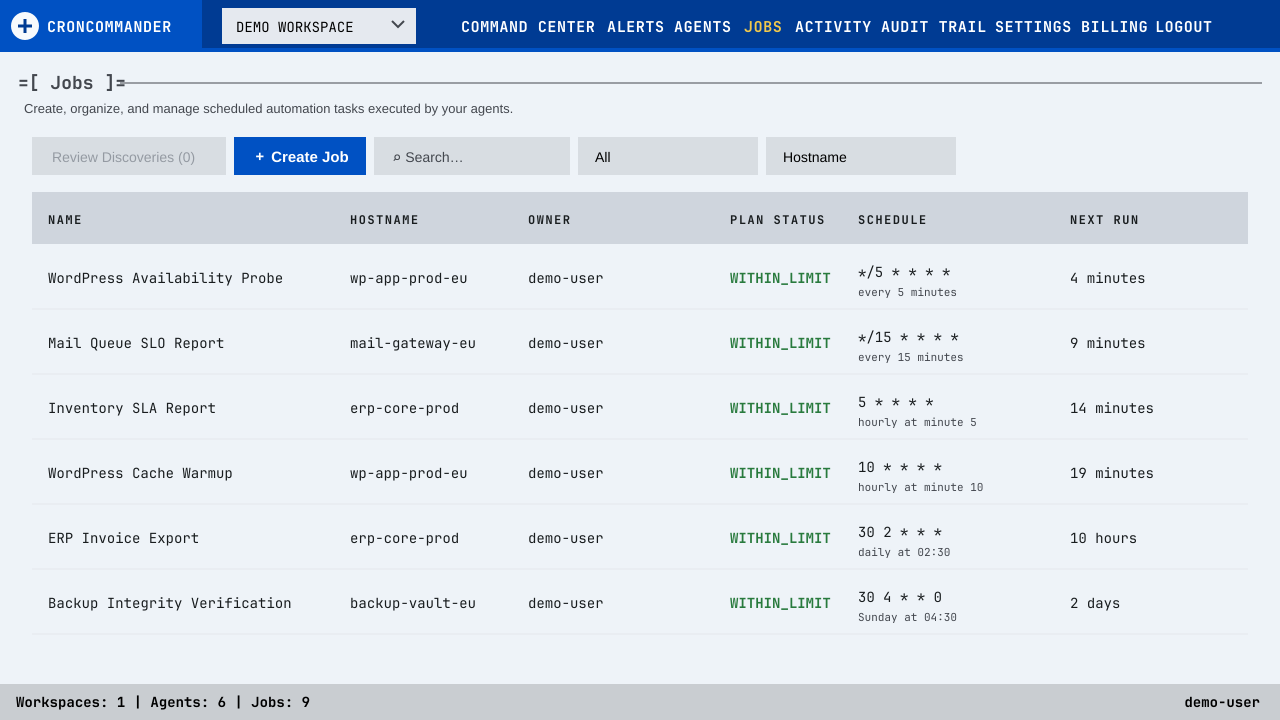
Every cron job. One place. No SSH.
Stop grepping servers one by one. See every job, schedule, and command across your entire fleet in a single unified view.
Know if jobs succeed or fail — before users notice
See success rates, execution times, and recent history for every job. Catch failures early, not after the damage is done.
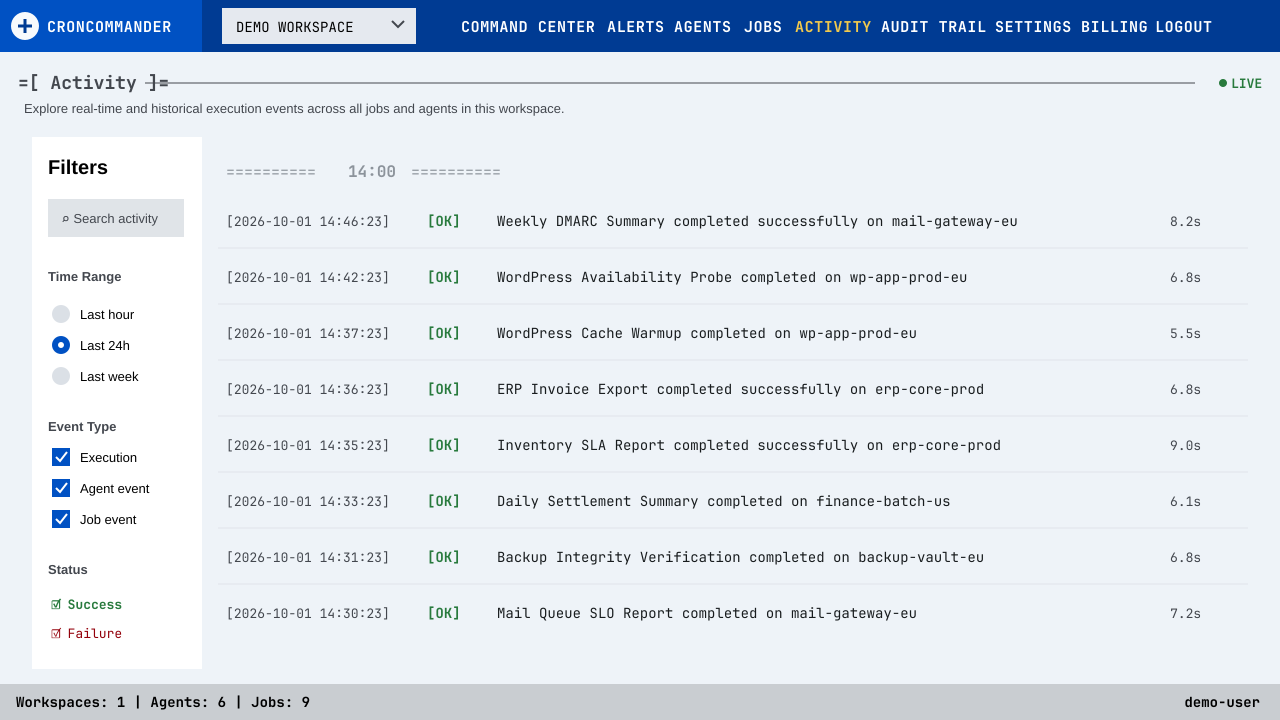
Full execution history. Always.
Every execution is recorded — what ran, when, and what happened. Filter by job, agent, or time range. Complete audit trail for compliance.
See what happened — without SSH
Click any execution to inspect stdout, stderr, and exit codes. Debugging cron should not require logging into servers.
Output captured...
Cron management for servers, agents, and crontabs
CronCommander is built for teams searching for a practical cron manager: a way to discover cron jobs across servers, keep crontabs in sync, and monitor every execution without replacing the cron daemon already installed on each machine.
Each server runs a lightweight cron agent that reports job inventory, liveness, schedules, stdout, stderr, and exit codes to the CronCommander control plane. You can manage crontab state from one place while the actual commands continue to execute locally on your infrastructure. Drift reporting and remediation remain roadmap work.
- Cron agent
- A small local service that reports server health, cron discovery, execution history, and desired-state sync.
- Crontab manager
- A central view for schedules, commands, ownership, failures, and changes across many servers.
Public launch readiness
Updated . Target public launch: October 2026. Early access remains open; deployed features and verified controls are separate from the remaining launch gates below.
Deployed and verified
-
sync
Agent installation and transport
Checksummed Linux installation, scoped HTTPS credentials, randomized polling, durable acknowledgements, and local report spooling.
-
travel_explore
Discovery and desired-state sync
Review and import existing cron entries, manage definitions centrally, and synchronize effective changes to enrolled agents.
-
rule
Workspace roles and Agency approvals
Account and workspace permissions are enforced. Agency Editor changes require independent administrator approval before they reach agents.
-
monitoring
Execution visibility and audit history
Inspect failed runs and bounded output, filter Activity, and export the Audit Trail with plan-aware retention.
- person_check
Job ownership lifecycle
Track accountable owners and team labels. Removing eligible access unassigns jobs without stopping schedules; administrators can reassign them with history preserved.
- verified_user
Identity and session controls
Google and email/password authentication, verification/reset action codes, session revocation, logout, and cross-account access controls have passed deployed checks.
- payments
Sandbox billing and customer portal
Test checkout, location-based tax, signed webhooks, subscription activation, plan previews, and the new-tab customer portal are verified. Live payments are not yet signed off.
- monitor_heart
Operational controls
Private metrics, alert delivery, backups, isolated restores, and a traffic rollback drill are verified. Recovery must preserve the new permission controls.
Remaining public-launch gates
- payments
Live billing and quantity lifecycle
Complete Pro/Agency subscription and agent-quantity changes with an isolated test account, then record live-mode billing acceptance.
- mail
Email delivery and Google branding
Confirm verification and password-reset messages in a real inbox and complete Google's branding verification.
- security
Credential rotation and security sign-off
Finish the remaining credential rotations and historical-revision cleanup, then record final security approval.
- fact_check
Public-launch approval
Review the completed acceptance evidence and documented release exceptions, then record the launch owner's final approval.
Future improvements, not launch gates
Email invitations, group-based team permissions, automatic replacement-owner rules, and approval-aging notifications remain planned. Team names are labels, not access-control groups.
"Security is a first-class concern. We prefer delaying features over shipping something unsafe."
Technical Specifications
laptop_windows Supported Systems
The CronCommander agent runs on Linux, FreeBSD, and macOS (amd64, arm64). The automatic service installer supports Linux; FreeBSD and macOS use the published checksummed binaries with manual service configuration.
shield Operational Design
- check_circle Local execution: Cron jobs run on your servers, so commands never leave your infrastructure.
- check_circle Small footprint: The agent is a lightweight, single Go binary designed to use minimal server resources.
- check_circle Open and inspectable: Review the agent source and documented protocol, or compile the agent yourself.
Your infrastructure runs on cron.
Take control of it.
No replacement. No lock-in. CronCommander is the control plane cron never had.